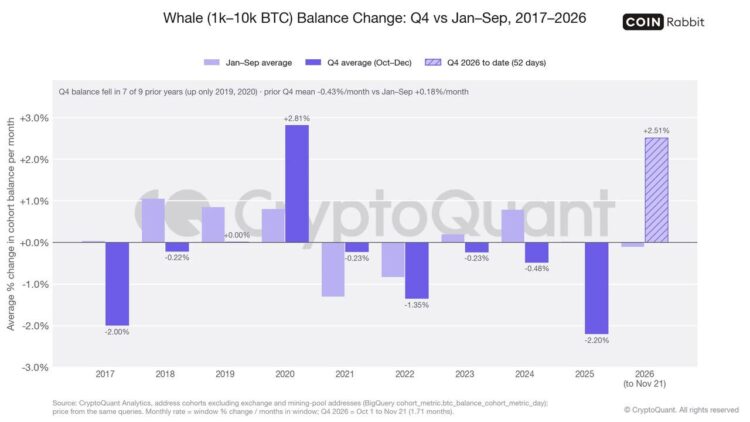
Addresses holding 1,000 to 10,000 BTC added a net 121,117 BTC between September 30 and November 21, 2026, while Bitcoin’s price fell 29.5%. At a reference price of $61,000 per coin, the increase was worth about $7.4 billion. That is a valuation of the coins, not a measure of money spent buying them.
CryptoQuant’s November 27 research report, supported by crypto lender CoinRabbit, put the group’s combined balance at just under 2.95 million BTC on November 21, up from 2.83 million BTC at the end of September. Its balance figures exclude exchange and mining-pool addresses.
The 4.29% rise was the group’s largest fourth-quarter gain since 2020, with December still to come. Balances had fallen in seven of the previous nine fourth quarters; 2019 and 2020 were the exceptions. In the full fourth quarter of 2025, the group shed nearly 203,000 BTC.
What an address balance measures
A transfer can push an address above the 1,000 BTC threshold. Its balance then counts toward the group total even if no coins changed hands in a market purchase. The increase shows where more Bitcoin was held, but not how much fresh capital entered the market.
The choice of addresses matters, too. Maketo counted 7.22 million BTC in addresses holding at least 1,000 BTC on November 26, up 54,379 BTC over 30 days. That measure has no 10,000 BTC ceiling and includes exchange and custody addresses. It answers a different question rather than independently confirming CryptoQuant’s figure. Likewise, the more than $2 billion in US spot Bitcoin ETF outflows reported by NewsBTC does not establish that investors moved from funds into direct ownership.
Balances rose as the profit margin narrowed
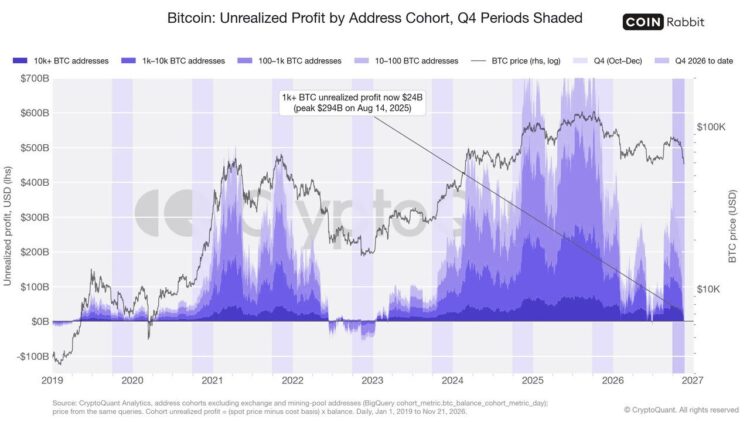
For CryptoQuant’s 1,000-to-10,000 BTC group, the unrealized profit margin fell from 33.9% at the end of September to 5.7% on November 21, its lowest reading of 2026 in the report. The margin was still positive, unlike the group’s average margins in the fourth quarters of the 2018 and 2022 bear markets, when its balances also fell.
For the broader group holding at least 1,000 BTC, unrealized profits fell from a peak of about $294 billion in August 2025 to about $24 billion on November 21, 2026. That group also recorded roughly $2.1 billion in net realized losses over the quarter’s first 52 days. The two measures describe different coins: a group can retain an estimated profit on the coins it holds while moving others below their estimated cost.
Exchange inflows from transaction outputs of at least 1,000 BTC averaged 5,012 BTC per day in November through the cutoff, up from 3,239 BTC in October. Even so, the quarter-to-date average of 3,955 BTC per day remained below the 2019–2025 fourth-quarter average of 4,575 BTC. The measure tracks large outputs, not individual holders, and a deposit is not proof of a sale.
Continued balance growth alongside easing realized losses, fewer coins flowing to exchanges in large outputs and renewed spot demand would offer stronger evidence of recovery. Through November 21, the data showed a change in the usual year-end balance pattern, not a market bottom.