As reported on November 24, 2026, the OKX–Intercontinental Exchange venture OKXICE opened a venue for tokenized US securities on November 23. It planned to introduce 113 assets in stages, despite objections from 67 companies to having their shares traded through the venue.
What does a buyer hold? According to the venture, each token represents a security entitlement backed one-to-one by an underlying share. Holders are entitled to dividends and voting rights where applicable. That is a different claim from a product designed only to follow a stock’s price, though the source does not establish how those rights would work in every case.
The venue’s November 20 notice named six assets for its initial session: Coinbase, Securitize, Strategy, BitGo, Robinhood and Circle, each paired with USDC. Trading was initially limited to eligible US customers of OKX Inc. who completed identity checks, activated a self-custodial wallet and finished onboarding. Approved-wallet restrictions also apply to trading and liquidity provision.
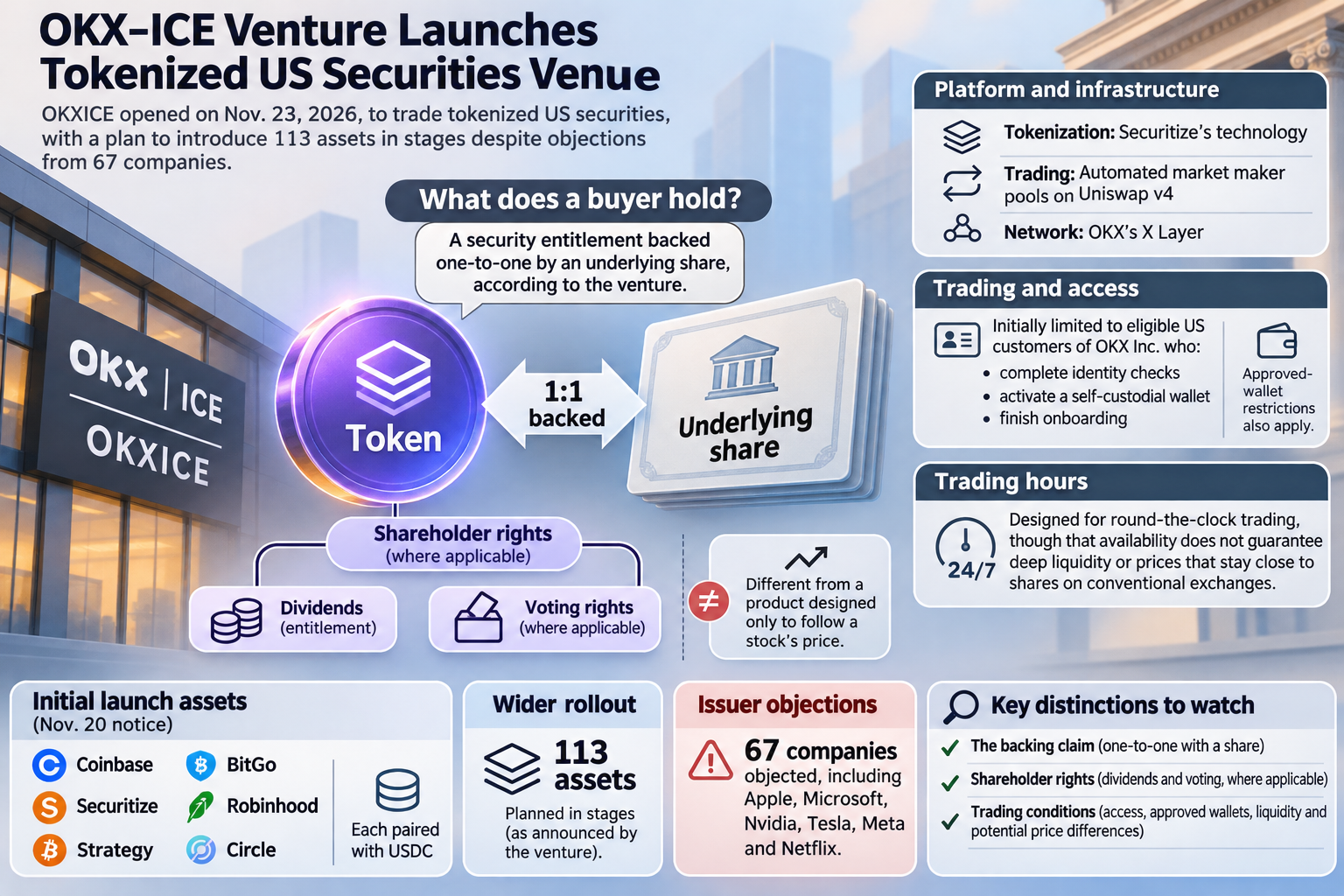
The proposed wider rollout remains contested. The 67 objecting companies included Apple, Microsoft, Nvidia, Tesla, Meta and Netflix. An objection to shares appearing on this venue does not, by itself, establish a company’s position on all forms of tokenization.
OKXICE uses Securitize’s tokenization technology and automated market maker pools built on Uniswap v4 on OKX’s X Layer network. The venue is designed for round-the-clock trading, but that availability does not guarantee deep liquidity or prices that stay close to shares trading on conventional exchanges. The backing claim, shareholder rights and trading conditions—not the token format alone—are the distinctions to watch.