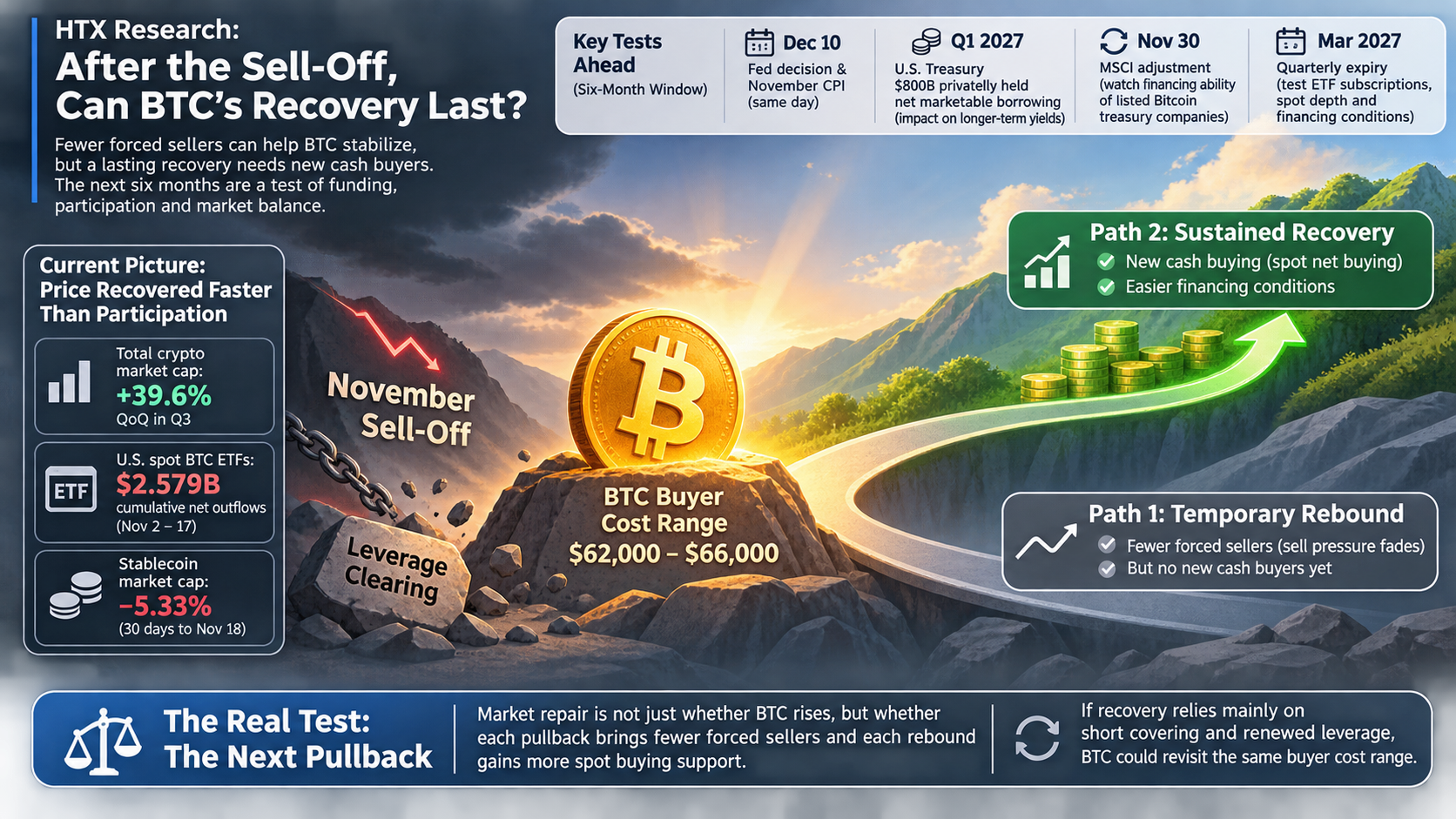
As reported on November 20, 2026, HTX Research’s answer was: fewer forced sellers would help Bitcoin stabilize, but a lasting recovery would require new cash buyers. Its six-month outlook separates a rebound caused by reduced selling from one supported by sustained inflows.
Price has recovered faster than participation
HTX Research noted that total crypto market capitalization rose 39.6% quarter over quarter in the third quarter, without a comparable increase in spot trading. The gap became more consequential during November’s decline. Citing Farside, the report put cumulative net outflows from U.S. spot Bitcoin ETFs at $2.579 billion from November 2–17. Citing DeFiLlama, it said stablecoin market capitalization had fallen 5.33% over the 30 days ending November 18.
The report placed BTC near a recent buyer cost range of $62,000–$66,000. Some leveraged positions had been cleared, it said, but new cash buyers had not yet appeared. A quick rise from that range would therefore not, by itself, establish that demand had recovered.
What could change the funding picture?
HTX Research argued that financing conditions over the following six months mattered more than any single interest-rate decision. Even without a Federal Reserve rate increase, delayed expectations of easing could raise the expected cost of holding a financed position. The report also distinguished easing alongside cooling inflation and stable income from rate cuts prompted by a sharp deterioration in demand; it did not assume those paths would affect BTC in the same way.
The report identified several tests ahead. It cited a U.S. Treasury estimate of $800 billion in privately held net marketable borrowing for the first quarter of 2027, and suggested that more long-dated issuance could lift longer-term yields. It viewed February’s quarterly refunding as a check on that possibility. It also noted that a Fed decision and the November CPI release were scheduled for December 10, potentially prompting two reassessments of the policy outlook in less than a day.
Institutional access does not guarantee institutional buying. HTX Research argued that, if listed Bitcoin treasury companies faced narrower share-price premiums or more expensive financing, anticipated future purchases could diminish even without those companies selling BTC. It proposed watching their ability to raise funds after a November 30 MSCI adjustment. For scale, the report put the November 17 ETF net outflow at about $240 million—roughly eight times its estimate of the nominal value of Bitcoin’s daily new block subsidy.

The test is the next pullback
HTX Research’s proposed measure of repair was not simply whether BTC rose. It was whether successive pullbacks produced fewer forced sellers, while rebounds gained more spot buying support. The report viewed the quarterly expiry in March 2027 as a further test: stable ETF subscriptions, spot-market depth and financing conditions after a pullback would be stronger evidence of improved market balance sheets than an uninterrupted price rise.
This remains a conditional model, not a forecast that buyers will arrive. In HTX Research’s view, spot net buying and easier financing could turn a temporary rebound into a longer expansion. If the recovery rests mainly on short covering and renewed leverage, Bitcoin could instead revisit the same buyer cost range.