In a podcast aired on November 14, 2026, Arthur Hayes argued that a Federal Reserve rate hike could increase interest income for banks and holders of short-term US government debt. He suggested that some recipients might use that income to buy Bitcoin. This account of the discussion was published on November 17, 2026.
Hayes’s question is about the quantity of money reaching asset holders, rather than just the price of borrowing. As an example, he assumed $3 trillion in bank reserves and $7 trillion in short-term Treasury bills. A 0.25-percentage-point rise in interest paid on each amount would imply $7.5 billion and $17.5 billion, respectively, in additional annual interest—if the full rate change applied to both balances.
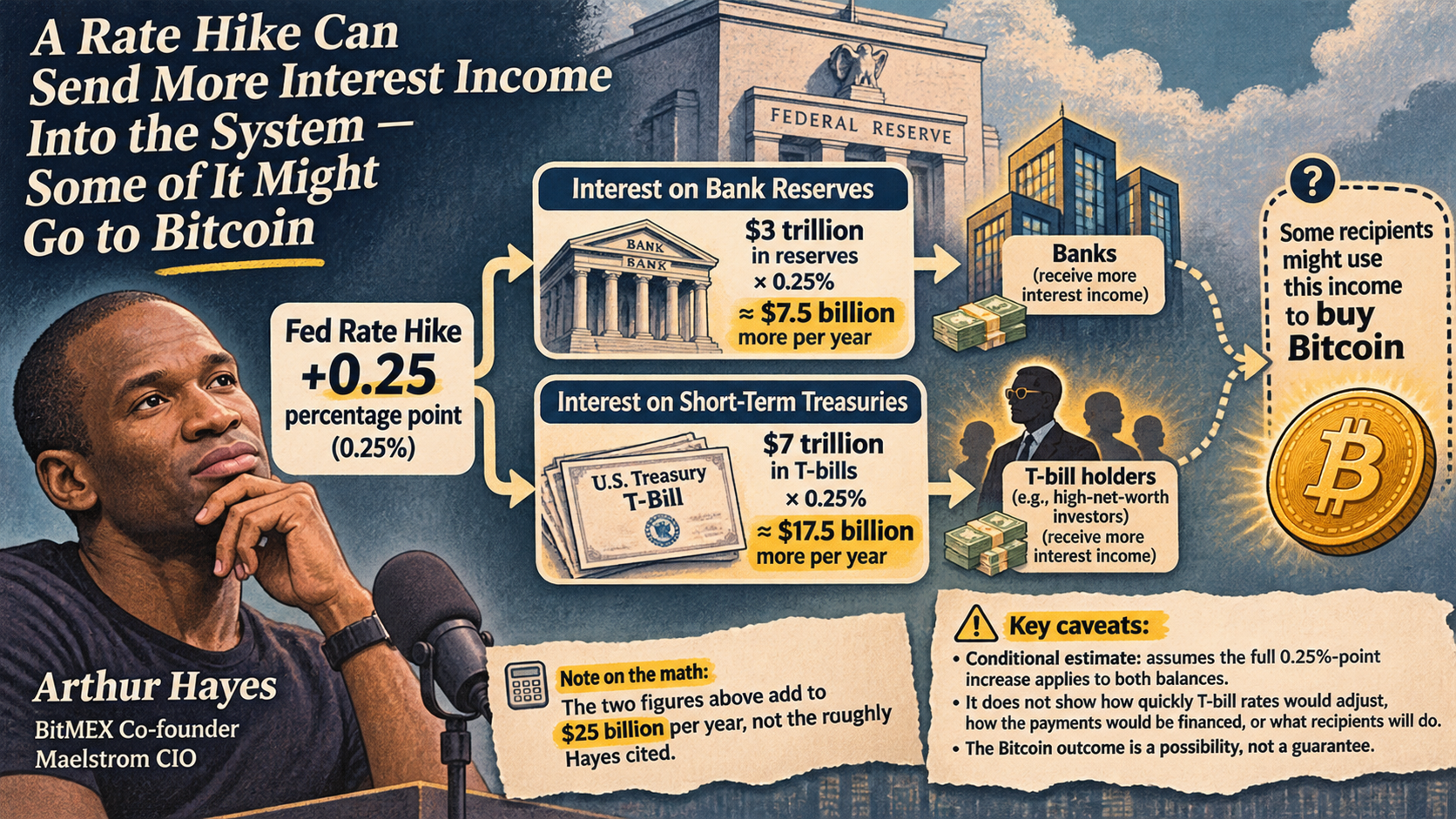
There is an important discrepancy in the reported calculation: those two figures add to $25 billion a year, not the roughly $22.5 billion Hayes cited as his total. The calculation is also conditional. It does not establish how quickly rates on outstanding Treasury bills would change, how the payments would be financed, or whether recipients would buy Bitcoin rather than hold or spend the income elsewhere.
Hayes’s broader claim is that interest payments can offset some of a rate hike’s tightening effect in a heavily indebted economy. That is a possible channel to examine, not evidence that a hike creates a fixed amount of new money or causes Bitcoin to rise. His Bitcoin conclusion depends on what happens after the interest is paid.